Tana Green

Agency of record: Accenture (Experience Agency), for a confidential global industrial client. I worked alongside two other designers and a project manager, supported by engineering consultants who knew the corporation's maintenance methods and requirements. I produced the storyboard wireframes and co-built the Axure prototype with a second UX designer, and art-directed the Windows 8 UI and functional requirements with a graphic designer. The user personas and final UI mockups were produced by colleagues from my wireframes and creative direction.


On sites measured in acres, a field maintenance engineer who needed a component's service record or a supervisor's input often had to walk back to a central office — a daily drag on efficiency and safety, compounded by paper-based documentation. Accenture (Experience Agency) engaged a small team to study the problem and propose a digital alternative: a Windows 8 tablet that would put accurate records in engineers' hands at the asset and let them reach colleagues by secure video without leaving the field. I led the interaction design as an individual contributor — the storyboards, the prototype, and the UI art direction — within that team.
The team's understanding of the work was grounded in engineering consultants who knew the corporation's maintenance methods and operational requirements firsthand. Three user personas — developed by another UX designer on the team — identified the primary users (field engineers and their managers) and served as a shared metric for keeping the design aligned to real staff operations. The recurring problem these inputs surfaced was distance: documentation and expertise lived in a central office, while the work happened across a large physical site. Field observations from our SME stakeholders informed the personas, which we then refined with consultant input.
North star and principles:
The concept brought three capabilities to the point of work on a Windows 8 tablet. Standing in front of a component, a field engineer could pull up its full maintenance history rather than hunting for paper records; open and act on the relevant work order in the same view; and start a secure, real-time video call with a supervisor — collapsing acres of walking into a conversation. The nine story flows traced this down the work-order lifecycle: an operations manager releases work orders, a field supervisor assigns packages, and a field engineer receives them, reads them against nearby work, and executes. For managers, role-specific dashboards surfaced maintenance activity and work-order status for Engineering and Field views at a glance.


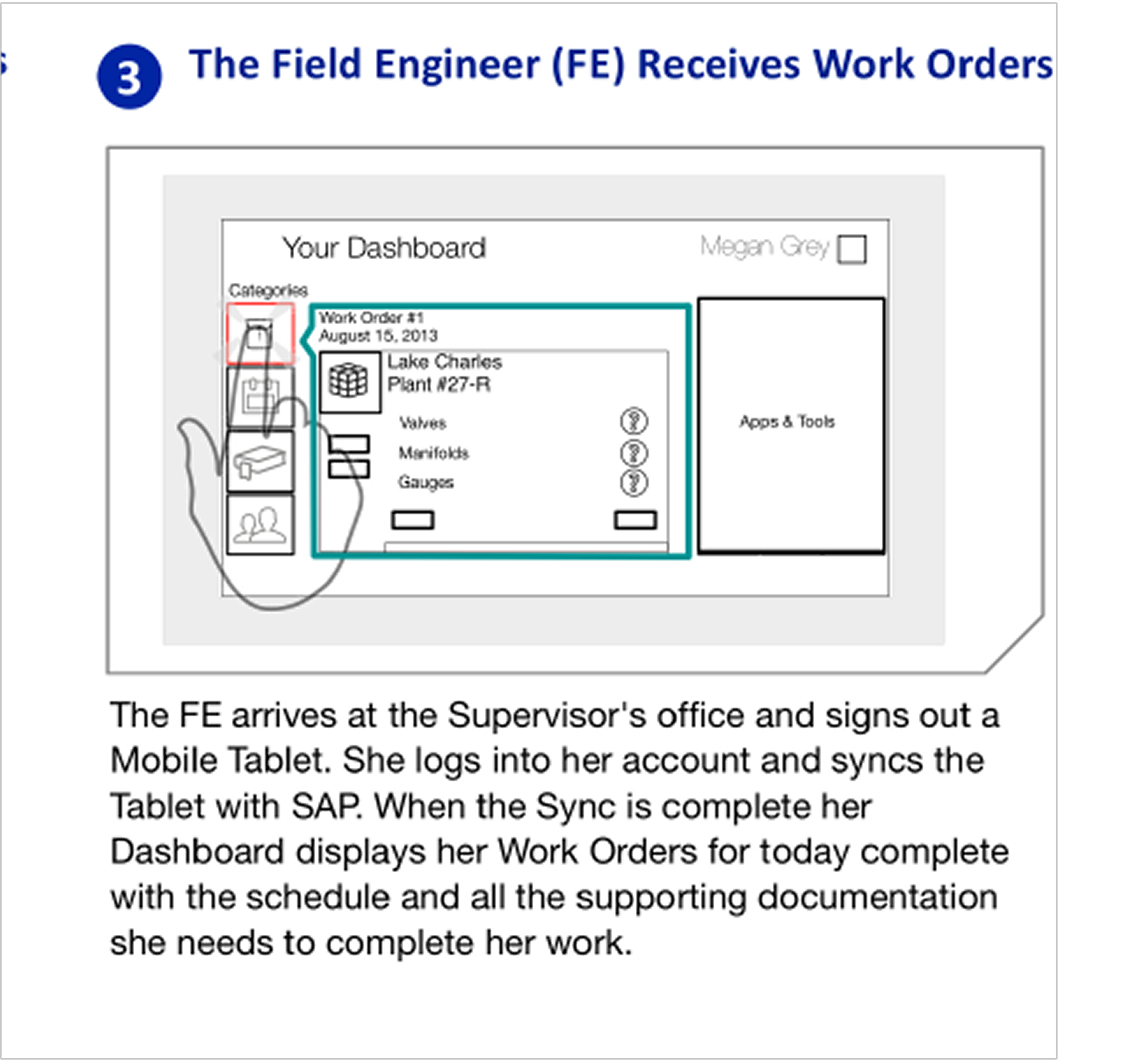


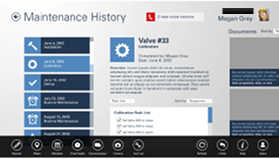


The proposal was shaped with two engineering consultants who workshopped the concept with the team to validate feasibility and operational fit against the corporation's real maintenance methods. Working from my UX storyboards, the team produced the final assets delivered to the client: storyboards, three personas, an Axure prototype, dashboard concepts, and art-directed Windows 8 UI, packaged as a demonstration with a complete proposal.


The engagement delivered a complete, client-ready proposal proof of concept demo package. As a study and proposal it was not taken into production, so there are no deployment or adoption metrics to report.
What I'd improve next: the most valuable idea (secure in-field video) was also the least proven on 2013-era tablet hardware and plant networks, and the proposal would have landed harder with a lightweight feasibility check (connectivity, device durability, security review) attached to the experience vision. I would also validate the personas with real field engineers before locking the flows.